MIKE RICCETTI
  • The best of Houston dining
    • Best Values
    • Breakfast
    • Chinese
    • Cocktails
    • Fajitas
    • Hamburgers
    • The Heights
    • Italian
    • Indian / Pakistani
    • Mexican
    • Middle Eastern
    • Pizzerias
    • Sandwiches
    • Splurge-Worthy
    • Steakhouses
    • Sushi
    • Tacos
    • Tex-Mex
    • To Take Visitors
  • Musings on Houston Dining
    • The best new restaurants to open in 2025
    • The best new restaurants to open in 2024
    • The best new restaurants to open in 2023
    • Houston's Italian restaurant history
    • Restaurants open for lunch (or brunch) on Saturday
    • Restaurants open for Sunday dinner
    • Restaurants open for lunch on Monday
    • Restaurants open for dinner on Monday
    • The top 10 new restaurants of 2022
    • The top 10 new restaurants of 2021
  • The margherita pizza project
  • The martini project
  • Italian restaurant history
  • Italian & Italian-American
  • Entertaining tips
    • Booze basics
    • Styles of Cheeses
    • Handling Those Disruptive Guests
  • Wine
  • Beer
  • Cocktails and Spirits
  • Miscellaneous
  • Blog
  • The best of Houston dining
    • Best Values
    • Breakfast
    • Chinese
    • Cocktails
    • Fajitas
    • Hamburgers
    • The Heights
    • Italian
    • Indian / Pakistani
    • Mexican
    • Middle Eastern
    • Pizzerias
    • Sandwiches
    • Splurge-Worthy
    • Steakhouses
    • Sushi
    • Tacos
    • Tex-Mex
    • To Take Visitors
  • Musings on Houston Dining
    • The best new restaurants to open in 2025
    • The best new restaurants to open in 2024
    • The best new restaurants to open in 2023
    • Houston's Italian restaurant history
    • Restaurants open for lunch (or brunch) on Saturday
    • Restaurants open for Sunday dinner
    • Restaurants open for lunch on Monday
    • Restaurants open for dinner on Monday
    • The top 10 new restaurants of 2022
    • The top 10 new restaurants of 2021
  • The margherita pizza project
  • The martini project
  • Italian restaurant history
  • Italian & Italian-American
  • Entertaining tips
    • Booze basics
    • Styles of Cheeses
    • Handling Those Disruptive Guests
  • Wine
  • Beer
  • Cocktails and Spirits
  • Miscellaneous
  • Blog
MIKE RICCETTI

Mostly food and drink...

...and mostly set in Houston

The label you might have seen in the wine shop has been around for over a century

7/3/2024

0 Comments

 
I recently returned from a trip to Piedmont: Turin, Monferrato and the Langhe, with plenty of wine on the agenda, and more on the table and afterwards. One of the winery visits was to the historic and well-known Pio Cesare, which is best known for its Barolos, and is the only winery left in the delightful town of Alba. The general, public tour and tasting we had booked was very entertaining and definitely recommended. Our guide, Davide, did a terrific job over the two hours or so.
 
One of the interesting things he pointed out in the subterranean cellars built around Roman ruins was a bottle from the first vintage packaged like that for commercial sales, from 1916, which was shown next to one from a recent release, 2018. The bottles were nearly identical. This might be a part of the winery’s success over the years, work from a graphic artist: an attractive and recognizable label, and then name, that is easy to remember and discern when shopping for wine.
 
Branding can be very important. From the worlds of consumer foods and dining, there are the Keebler elves, Frosted Flakes’ Tony the Tiger, the Pillsbury Doughboy, the Coca-Cola logo, and McDonald’s arches to point out a few of the most well-known. Pio Cesare is not nearly in the same category in terms of consumer recognition, but its products are much more enjoyable, and natural, to be sure.
Picture
0 Comments

Yes, you can get a bad house wine in Italy; I just had a few there

6/24/2024

0 Comments

 
After getting stuck in a museum for an additional hour or so by what we later heard was the largest hailstorm in memory in Turin and first finishing a warming bicerin in the closest open café, I ordered a half carafe of Dolcetto, a grape that is widely planted in the region. It was shockingly awful, even when I felt in need of a drink, suggestive to me more the output of a process plant than a winery. My mom, who long has had a tolerance for very inexpensive wines, said it tasted “worse than a bad jug of Gallo.” That was just the first of three mostly bad carafes of house wines.
 
During my first few trips to Italy, when both my wallet and palate were lighter, I really enjoyed the house red wines. That was often in Tuscany, though, where there is more inexpensive good red wine than elsewhere in Italy. But that held true a little over a decade ago, too.
 
The second bad one was at a humble and unexpectedly quite good trattoria in the hills overlooking Santa Margherita Ligure. The salumi and cheeses to start were terrific, even at times rustic. With the first sip of the red wine from the carafe, I pronounced to my chef sister-in-law, “This is grim-tasting.” The seven of us at the table didn’t come close to finishing it. The third was in a humble, friendly spot in over-touristy Portofino. The meal satiated the hungry, the fizzy white wine called Verduzzo – maybe actually from Friuli – was mediocre, maybe that.
 
The last carafe was actually quite tasty and well-made, a Dolcetto, too. After a couple pleasing sips I looked at the glass bearing the name of the winery, Cantina di Nizza, the nearby cooperative winery where we had more than a few surprising and each very enjoyable boxes of wine in varying sizes and labels with low prices.
 
With more wineries eschewing vini sfusi, wine sold in bulk, inexpensive carafes of wine are seemingly tougher to get in restaurants in Italy. Also, I am certainly asking for more these days.
Picture
0 Comments

Which is the best cuisine in Italy?

6/23/2024

0 Comments

 
While finishing an excellent dinner at the trattoria Scannabue in Turin’s San Salvario neighborhood at the very start of the trip to Italy last month, we audibly noticed a dish just brought to the table next to us. The two diners at it, who had been speaking only in Italian, happen to respond in excellent English, one currently living in Seattle.
 
Friends originally from Bologna, after some talk about the dishes on the table, wine and the restaurant, we learned that they had once run a website that recommended restaurants throughout Italy as both traveled to much of Italy for work and vacation but eventually felt they could not compete with better-funded sites and publications like from Gambero Rosso. Hearing that led to more questions from me about which regional and local cuisines in Italy they thought were in the best.
 
The relative merits of regional and local cuisines in Italy is a topic of interest to many, myself definitely included. Italian geography and history – along with a climate suited to many wonderful fruits, vegetables, grains and wines – has given the country numerous distinct and often thrilling dishes and culinary traditions. Many of these have found homes in the U.S. As Italy has become wealthier after the Second World War, more people can fully partake in those, expanding old traditions while new ones have also arisen. And restaurants in Italy are better than ever.
 
Being from Bologna, the two thought Bolognese cuisine was the best, of course. That food exemplified by a richness featuring fresh pasta like tortellini and ragù Bolognese, and lasagna and foodstuffs like prosciutto, mortadella and Parmigian-Reggiano is often the top choice of many Italians I’ve queried over the years, but which would assuredly be after their hometown cooking wherever that was. The also-rich Piedmontese cuisine, known best for the luxurious aromatic white truffles each fall, was likely second, and that Turin was a great city in which to dine. They agreed with me that Tuscan was surely overrated and less interesting, though it does have Italy’s only culture of steak; Marchigiano from across the Apennines is certainly better, as the Marche is actually more beautiful, too.  And they quickly dismissed the Milanese cooking: “It only has two dishes.” Two dishes? I asked. There is costoletta, osso buco and risotto alla Milanese, to start.  “Costoletta and rice with the sauce of the osso buco, that’s just two.”  Maybe they passionately hated both AC and Inter Milan.
 
That was humorous, and typical of still-current Italian regional and local chauvinism. But he might have had somewhat of a point about Milan. Noted Italian cookbook author Ada Boni wrote, even in the 1960s, that “Good Milanese cooking is rare in the city itself, but in the old part of the city and in certain trattoria in the outer suburbs it may still be found by the enterprising and inquisitive gastronome.” And the city has certainly changed in the intervening six decades while it has drawn more people from elsewhere in Italy elsewhere.
 
I feel the need to dine some more in Milan. And elsewhere in much of Italy, for that matter. I have to Sicily and the Sicilian cooking, with access to large fish like tuna and swordfish and other seafood is regarded to be among the healthiest in Italy along with being very flavorful. Roman cooking has given the world, and tourist Italy, the famed pasta dishes cacio e pepe, all ‘Amatriciana and Carbonara. And a fourth, that they don’t’ publicize anymore, Alfredo. There is also carcioli all romana and carciofa all giudi pinzimonio, abbacchio, suckling lamb, porchetta, saltimbocca and pizza al taglio and a trattoria tradition for robust than elsewhere. Neapolitan, often quickly cooked excepting its famed Sunday ragù, has given much to the Italian-American fare I grew up with is probably my favorite though I have spent less than a week in the Naples area. Pizza, spaghetti, and marinara, octopus, mussels, clams, squid often topping that pasta. Mozzarella. Eggplant Parmesan. Among some of the others, Venetian, with its fruits of the Lagoon, robust, delicious Abbruzzese, and lighter Ligurian, with its olive oil-laden pesto, focaccia and dishes with small fish.
 
It’s a fun subject to muse about the regional and local Italian cooking, as we did for a little while with some strangers who were quite passionate about it. I have since thought what should be included when talking about cuisines. The dishes, the foodstuffs, maybe the wine, too, and likely the quality of the restaurants, which is where nearly all of us experience the cuisines.
 
More research is needed, even if the question doesn’t really need to be answered. Just explored.
Picture
0 Comments

Nebbiolo, the more approachable and affordable preview of Barolos and Barbarescos

6/20/2024

0 Comments

 
Needing to restock after returning from two-and-a-half weeks in northwestern Italy then France, I stopped at the big Kroger on 11th Street the other day, the one with a nice wine selection, and felt compelled to pick up at least a couple of bottles of wines labeled “Nebbiolo.”
 
Before the trip, which was largely in Piedmont, I hoped to learn more about the region’s star grape, Nebbiolo, that becomes Barolo and Barbaresco in its most exalted forms. A visit to 13 Celsius prior to leaving and sampling a 2022 G.D. Vajra Langhe Nebbiolo had convinced me that these were worth exploring, too. Nebbiolos are the lesser-aged, less fussed about, easier to drink and much more affordable, if less complicated bottlings from the Barolo and Barbaresco producers. I returned also with an enthusiasm about those.
 
These Nebbiolos were created, in part, to provide income while the Barolos and Barbarescos are aging, similar to the Rossos from Montalcino and Vino Nobile in Tuscany. But Nebbiolos have struck a cord, certainly at least where it is produced, becoming the everyday wine for nearby Alba and much of the area, at least for younger drinkers, I was told, displacing Dolcetto, long the wine found on most lunch and dinner tables. This has been helped by the changing climate that has made the fickle and late-ripening Nebbiolo grapes easier to grow well. As Aldo Vacca, the former head of Produttori del Barbaresco, said on Levi Dalton’s podcast: “There are really no bad vintages anymore.” Like Barolos and Barbarescos, Nebbiolos are better than ever and there is more of it, too.
 
Nebbiolos don’t have the complexity nor depth of flavor of the Barolos and Barbarescos, but exhibit the pleasant red fruits and maybe a spiciness with noticeable acidity and tannins. But those tannins, especially, are muted compared to the younger Barolos and Barbarescos that are on most restaurant menus, and what most people here drink at home making a Nebbiolo often a better choice with the meal. This was my experience at lunch recently at Campamac, an ambitious, Michelin-cited restaurant in the village of Barbaresco. When I asked for a Nebbiolo – I had to have something with that grape in Barbaresco – the enthusiastic, youngish sommelier recommended what turned out to be a beautiful Bruno Giacosa from the 2022 vintage that he thought was more approachable than from the previous year. It went quite well with the agnolotti with wild goose and the Torinese take on the Milanese. He commented that the famed Bruno Giacosa was the second best Barbaresco producer after Gaja. By all accounts, true.
 
In addition to possibly being quite satiating and satisfying on their own, the Nebbiolo wines are also a chance to understand the winery better and determine whether or not you want to spend the additional money for their Barbaresco or Barolo. “Nebbiolo is a preview for Barbaresco and Barolo” according to Michela Cucca, my host when I visited Produttori del Barbaresco a couple of weeks ago. I was told at another winery that if you like their Nebbiolo, you will like their Barolo or Barbaresco. Davide Abram at Pio Cesare told us that “The better the Nebbiolo, the better the Barolo and Barbaresco.”
 
You can find Nebbiolos for around $20 to $30 retail. I quite enjoyed the Nebbiolo from Produttori del Barbaresco that has been available in Houston for a while, but I didn’t feel like paying $27 at Kroger for it after buying a couple of bottles for €15 a piece at the winery. The higher tariff is certainly worth it, though.
 
If you enjoy Barolo and Barbaresco, you should definitely seek out a Langhe Nebbiolo or a Nebbiolo d’Alba. Or if you just enjoy Old World wines are looking for a reasonably inexpensive wine to accompany a meal, you might give one a try.
Picture
0 Comments

The Focaccia di Recco, at Manuelina in Recco, where it began

6/15/2024

0 Comments

 
Last week, driving to Santa Margherita Ligure from Piedmont, I instigated a lunch stop in Recco to sample the famed Focaccia di Recco at its source, Manuelina. This is, in fact, its commercial originator way back in 1885. I was in the area and had to make a small detour try it.
 
Most Houstonians might only know, even if just by name, Focaccia di Recco from the version at Rosie Cannonball, a stalwart on its menus since opening a few years ago that has drawn raves and press from Alison Cook in Houston Chronicle, Eric Sandler in CultureMap and Houstonia among others. Quite distinct from the puffy, familiar focaccia found throughout Liguria, which I love – usually flecked with some rosemary when I have to order it – the Recco version features unleavened dough and is essentially a baked, thin, flat sandwich filled with cheese. Consisting of two very thin pieces of olive oil-laden dough featuring finely milled “top quality” high-gluten flour interspersed with dollops of stracchino, a creamy, mild fresh cow’s milk cheese from Lombardy, then drizzled with more olive oil, some salt and it is finally baked in circular cutouts in copper pans in a moderately hot oven until crisp.
 
Arriving at the table looking a lot like a Tex-Mex quesadilla, the result is that kind of cooking alchemy that you happily come upon every now and then, with the combination of seemingly simple straightforward components makes for something much more interesting and amazingly pleasurable. At the first bite I could understand why this dish has resonated so loudly. The classic version with just cheese, La Focaccia di Recco col formaggio IGP – it has its own protected designation – was crisp, gooey and wonderful. It made me think of a lighter, more refined, more Italian version of a grilled cheese sandwich. We also ordered version topped with slices of culatello, the cured heart of the prosciutto, and another with nduja, the greasy, piquant Calabrian fresh sausage. Both were terrific, though my favorite was the original, unadorned, and I had a tough time not picking up yet another wedge. With good reason Italian dining guidebook author Fred Plotkin called over a quarter century ago, “probably the most addictive food on the planet.” Even my Parisian-trained pastry chef sister-in-law was dutifully impressed with the focaccias.
 
Though the Focaccia di Recco was the reason for our stop, the rest of the meal was excellent and you can be assured of having a very enjoyable time without even ordering one. Anchovies and butter to start then a traditional Ligurian pansotti, a stuffed pasta, in a walnut sauce were both superb. The attention to quality extended to the top-notch German-style pilsner on tap from a long-standing small brewery in the Veneto and a tasty bottle of Rossese di Dolceacqua – which is not always so as we were to find out later – from the very short list of wines. Service was efficient, friendly accommodating and the lunch was comfortable and delightful throughout. The adjacent ristorante is Michelin-recommended and the quality of this focaccia-focused trattoria is indicative of the great utility of the Michelin guide, even for the related restaurants.
 
But, it you are going to visit, get the Focaccia di Recco, as every table in the dining room did, too.
 
Manuelina Focacceria Bistrot
Via Roma 296
16036 Recco (GE)
manuelinafocacceria.it/recco/
Picture
0 Comments

Anchovies and butter, common on northwestern Italian menus, should make a return here

6/12/2024

0 Comments

 
Returning from two weeks in northwestern Italy, I was struck how often I saw anchovies and butter on menus, first in Turin then elsewhere in Piedmont and later Liguria. A composition that always includes bread, sometimes toasted, might initially seem odd to most American diners. But the combination of salty, maybe slightly oily anchovy filets and rich, soft cultured butter along with a base of bread for works very well and makes for an excellent initial bite when dining out. It’s also an item that used to be seen fairly often on Italian menus of old in this country, part of the outsize legacy of immigrant restaurateurs from Piedmont many decades ago.
 
Though not near the ocean, Piedmont has a long culinary tradition with preserved anchovies from trade with nearby Liguria. It’s also got more cows than most other regions in Italy and long influence from butter-loving France just across the Alps.
 
My first experience with it on this trip was during lunch at Campamac, an ambitious, Michelin-cited restaurant in the village of Barbaresco. It arrived dramatically as an amuse bouche on three separate plates: oil-cured anchovies from Liguria, softened butter already portioned and a thick slice of slightly brown, rustic, freshly made sourdough bread. It made for a delicious couple of bites and start to the meal. A few days later at the excellent, casual Manuelina Bistrot in coastal Recco, I ordered the Pane, burro d'Isigny e acciughe salate del cantabrico for 10 euros – under the heading “Per Iniziare,” to start – sourcing widely to feature the lauded, creamy, rich butter, whipped, from Normandy and artisanal, salt-cured Spanish anchovy filets atop a thick, cracker-like toasted bread. A little different, with a more softened, lighter butter and more contrasting texture, I really enjoyed it also, a terrific preface to the rest of the meal.
 
This is a simple dish that I wish would make a return to menus here. Only three ingredients, but which need to be of high quality for it to work. It’s something easy to do at home, too, well-suited for entertaining guests as appetizers who might be at least somewhat open-minded.
Picture
0 Comments

Almost two weeks in Italy’s top wine region and most of the wine we drank came from a box

6/11/2024

0 Comments

 
Just returned from an enjoyable two-and-a-half week vacation in northwestern Italy and across the border in Nice. The wines of Piedmont, arguably Italy’s top region for red wine and wine overall, were a prime reason for the itinerary. An indicator of quality, the region is home to the most number of DOCG wines – the country’s top classification – at 19 – Tuscany is second at 11, and it also has the most of the second highest, DOC, tied at 41. Piedmont’s most famous wines, Barolo and Barbaresco, were on the docket and I visited several top producers, but most of the wine I drank was most commonly planted red grape there, the almost always enjoyable, and often much better than that, Barbera. And most of that came from a box. Several boxes, really. It was too palatable and fairly too easy on the wallet.
 
Among the wineries I had scoped out before the trip was one I had never heard of before, Cantina di Nizza, the local cooperative, which was just a six-minute drive from the house we rented. The reason was that it sold some of its wine in boxes, 10-liter boxes, something that I had never heard of, and for a song. I felt I had to pick one of those giant packagings. And, maybe, my family drinks wine quite readily. But these wines, in a half-dozen different versions, were easily the best wines I have ever had from a box, including at least a couple that Eric Asimov had touted last year. The Barbera Fruttoso, made with unclassified grapes, was easy to consume, 12.5% alcohol, with nice berry on the nose and palate, balanced acidity, and a fairly long, mostly smooth taste; well-noted as “ideal as a table wine, to accompany everyday lunches.” It was priced at a ridiculously low tariff of €22,50 for 10 liters. That works out to $1.81 per 750 ml bottle, while tasting better than probably most of the $15-20 bottles I purchase here. This would be a daily drinker if available here, even at a much higher price.
 
The best wine in a box we had was the L’Audace, a Barbera 2020 DOC, with a richer, more pronounced and serious taste at 14.5%. We went through a couple boxes of this, too, albeit at the punier 5-liter size, but pricier €23. Not just these two, but another Barbera option, Corposo, a fuller expression than the Fruttoso, was also very nice. And I especially enjoyed a Cortese DOC. These are good wines. Each of the several boxes we tasted were quite well-made as I am sure the other ones are, also. There are ten wines available in boxes, from 3- to 10-liter.
 
I’d recommend visiting Cantina di Nizza if in the area. It has a number of other wines, in bottles, some of which have earned two bicchiere from Gambero Rosso, best value citation also from Gambero Rosso, and medals from the top British wine publication, Decanter, ranging from under €10 up to just €24. Though less atmospheric than most other wineries in the region, the wines are of high quality and even those in box can be tasted before buying. I found it fun to sample wine poured straight from a 10,000 or so-Hl stainless steel holding vessel, which was quick and unpretentious, if a tad incongruent with the caliber of the wines.
 
Cantina di Nizza
Strada Alessandria, 57
14049 Nizza Monferrato (Asti) – Italy
 
tel. +39 0141 721348
Picture
0 Comments

You might enjoy the ‘house’ red at 13 Celsius

4/29/2024

0 Comments

 
For customers at 13 Celsius who are in the mood for a red wine but not sure which one, the staff can be quick to suggest the Patina Due Gelsi Barbera d’Alba from the 2021 vintage. I’ve long been a fan of Barberas – actually traveling to that area again next month – and this is an easy one to enjoy.  With some berry and cherry notes on the nose, the first sips are smooth, dry, with less immediate acidity that Barbera was once largely known for.  It has a nice body, rich and with some tannins from the wood-aging but those are not prominent. It is easy wine to drink without food; the 15% alcohol is pleasantly obscured.
 
This will readily appeal to most fans of Italian reds and it has also resonated with a big range of red wine drinkers at 13 Celsius.  This is truly a house wine, too.  It is made by Guidobono, which produces several wines including a Barolo in the Langhe and Roero in Piedmont, exclusively for 13 Celsius under the Patina label and found nowhere else.  You’ll notice that the label features a photo of the distressed tin tile ceiling at the bar that might not quickly be noticed after the second glass.  The Patina Due Gelsi Barbera d’Alba is $13 for a full pour, and $7.50 for 3-ounce half pour. 
 
13 Celsius
3000 Caroline (just north of Elgin), 77004, (713) 529-8466
13celsius.com
Picture
0 Comments

Ungainly, messy, and absolutely delicious; the new meatball sub at Elro

3/2/2024

0 Comments

 
I am a big fan of Elro and it’s unique, smart and very approachable take on upscale casual dining, believing it was one of the top new restaurants to open in the city last year. Texas Monthly recently opined the same thing. Having dined there about ten times already – it’s nearby and easy for me for lunch which helps – and being sucker for a good sandwich, especially an Italian-accented sandwich, I was looking forward to its second sandwich offering, the Meatball Sub that debuted after my last visit.
 
And that is a favorite for many. The meatball sub finished number thirteen on a YouGov survey of the country’s most popular sandwiches a few years ago. I do like it when done well or even fairly well, though it’s number three for me among hot Italian-American sandwiches. With family roots in Chicago, Italian beef has been tops for me probably followed by Veal Parm – though I haven’t had a good one of those in a quarter century. Elro’s version of the meatball sub might change my sandwich pecking order.
 
Its meatball sub was likely the best of that genre I’ve ever had. Arriving solo on a plate with its two halves enclosed in aluminum foil, it doesn’t make a striking appearance. Unwrapping a half of very hot sandwich gingerly reveals a crusty sesame seed-topped hoagie roll filled with beef and pork meatballs, melted provolone and mozzarella, with a judicious amount of a tomato sauce and, somewhat unusually, big leaves of basil. The meatballs, half pork and half beef, were soft and flavorful, and were complemented perfectly with the melted white cheeses, a lighter tomato sauce, the fragrant green herbs, and the wonderful, crusty bread, the same that’s used for The Hoagie. I made a small mess devouring it. Though a hearty sandwich, this is the freshest, lightest version of a meatball sub I’ve ever had: better bread, higher quality, tastier meatballs, the bit of basil, and fresh-tasting rather than a long-cooked tomato sauce.
 
Not so not inexpensive at $18, but a fair price for the quality and what will be a filling meal for most. It might be a favorite, too.
 
Elro
2405 Genesee (at Fairview), 77006
elrohtx.com
Picture
0 Comments

The proprietor of Houston’s first Italian restaurant was a Polish-American, Marion née Kowalski

2/21/2024

0 Comments

 
Italian restaurants have been popular in this country, some parts of the country, at least, since the big wave of immigrants from Italy in the late nineteenth century, becoming even more widespread than the significant numbers of Italians would indicate. But, it seemingly took until the end of 1926 for a full-time Italian restaurant to open in Houston.
 
There was Italian food publicly served on a special occasion, or occasions, before then. On July 20, 1924 both the Houston Post and Chronicle reported a society vignette that a certain Mr. and Mrs. Herbert Godwin gave a small dinner party “at the new Italian restaurant in Hermann park.” This was at the café that was opened to patrons of the golf course at the park by John Pappa and Vincent Vallone – Tony Vallone’s grandfather – the month before. This café seemed to also be used for private events, but was not really an Italian restaurant.
 
The honor of the first Italian restaurant in Houston appears to go to Mme. Cerracchio’s that opened in December 1926 in a “stately colonial mansion” at 2414 Main Street at half-block north of McGowen, in today’s Midtown. This also housed the studio of Mrs. Cerracchio’s husband, the sculptor Enrico Cerracchio, who created one of the city’s most iconic civic artworks, the bronze equestrian statue of Sam Houston in Hermann Park. The restaurant advertised table d’hote service from 6:00 to 9:00 PM and a la carte afterwards in “an atmosphere of refinement and culture.” She is quoted as saying a few months after opening that “I have always had the urge to show the Americans how the people in Naples, Enrico’s native city, serve their foods – and at last I’ve found the chance.” It offers “raviolis, meat balls, and fine Italian spaghetti.” Mme. Cerracchio’s was a more appealing-sounding for an Italian (and French) restaurant than that of her maiden surname.

She was born Marion Kowalski in Shamokin, a coal mining town in eastern Pennsylvania that, incidentally, was the also the birthplace of fellow Polish-Americans, Stan Coveleski, a Baseball Hall of Famer, and his brother Harry, who, too, pitched successfully in the major leagues, with a lifetime record of 81-55 and was a three-time twenty-game winner.
 
Coincident with her husband’s work as a sculptor, the restaurant becomes a “rendezvous for the artistic, bohemian element” as many Italian restaurants were famously known to be in New York, Chicago and San Francisco and elsewhere. Mme. Cerracchio’s adapts a slogan of “Where Houston’s ‘Who’s Who’ meets and entertains the Nation’s ‘Who’s Who’”. Nonetheless, it becomes Nino’s in August 1927, just eight months or so after opening, with a new proprietor. This is the first of three Italian-themed restaurants named Nino’s in Houston over the decades, none of them related.

If interested in reading more about the sometimes amusing and surprising history of local Italian restaurants like this, you might want to scroll through some of “A passeggiata through Houston’s Italian restaurant history.”

An advertisement from the Houston Post, March 2, 1927. The address is incorrect.
Picture
0 Comments

(Beef) tacos de trompo at Tacos del Julio

2/19/2024

0 Comments

 
I hadn’t been to Tacos del Julio in almost a decade and it had been in mind recently after visiting Feges BBQ and Stuffed Belly as one of its locations shares the revitalized now restaurant-heavy strip center on Long Point west of Wirt. I had liked its casual Monterrey-rooted food in the past; it was recommended it in my guidebook Houston Dining on the Cheap some years ago.
 
So, after long last, I drove out there for lunch today. An item at the top of one part of the menu caught my eye: tacos de trompo with beef. I don’t remember having that before – and knowing it existed – and really enjoying well-crafted tacos al pastor and tacos de trompo made with the traditional pork, I ordered it after the waiter confirmed it really was beef sliced from a trompo.
 
Arriving at five to order set flatly on a plate, the marinated slices of beef, which had been slightly crisped on the plancha were set atop a pair of fairly substantial, deep yellow corn tortillas with a bit of melted asadero cheese in between then topped with sauteed onions and slices of avocados. After liberating them from the three separate small plastic bags, accompanied with squeezes from lime wedges, chopped cilantro and chopped fresh onions. With some squirts from the bottle of spicy, flavorful orange salsa, made with chiles de arbol, I assume, the tacos were terrific. The beef was tender, more tender, mildly beefy but much tastier than the beef in a typical taco. With all the complements, even much better.
 
For just $12.49, which came with a cup of nicely satisfying charro beans, it was quite a nice deal. Their slogan is spot on, certainly with this order: ¡No comas ansias, come tacos! When here, don’t worry, eat tacos.
 
Tacos del Julio
8203 Long Point (east of Wirt), (832) 358-1500
tacosdeljuliousa.com
 
Locations also on I-10 in Katy and at 7515 Westheimer. There are two other operators of the restaurant have locations on Airline Drive, in Pasadena, and then one on Highway 6.
Picture
0 Comments

Another sandwich to tout: Winnie’s East Coast Italian

2/13/2024

0 Comments

 
I met an old friend the other day for lunch at Winnie’s, a place I have always liked but had not been in a little while. The reason is that the less-than-ideal parking there in a crowded part of Midtown is seemingly always in the back of my mind. Very glad we went there.
 
Winnie’s menu has grown, and it now sports a half-dozen or so sandwich options in addition to a couple burgers and an obligatory wrap in addition to a number of other slightly whimsical and always well-crafted choices. I ordered a new sandwich for me, the East Coast Italian. It’s their take on the classic sub or hoagie, which I am partial. A lot of folks are partial to that style: it’s launched several national sandwich chains, after all.
 
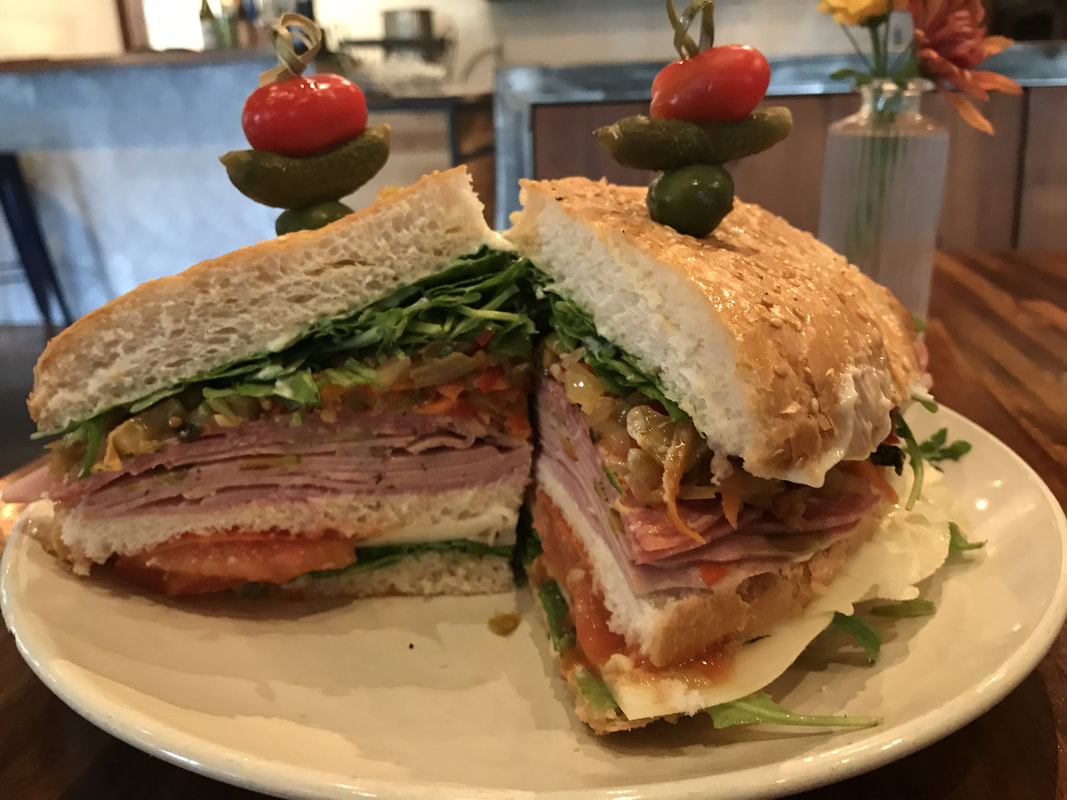
The East Coast Italian has about a dozen components: mortadella, ham, mild capocollo – or cabbacall in my grandfather’s dialect or the cruder-sounding gabagool on the menu that’s familiar from The Sopranos – sliced provolone, a bit of tangy cherry peppers, relish, lettuce, tomato, sliced red onions, mayonnaise, oil and vinegar, and whatever exactly Italian seasoning is all within a fresh sesame-seed-topped hoagie roll from local Luloo’s bakery. Those all play very well together. It’s a great mix of flavors, with enough enjoyingly contrasting textures and easily-good-enough ingredients, notably the bread.

It's delicious and fairly substantial in a whole order, not quite tasting like a classic Northeast sub but something very well-suited for just about any cold sandwich-lover here. And something else to keep in mind when visiting Winnie’s. It’s been tough for me to go wrong here food-wise. Though it is a little out of the way for most for lunch – and that parking  – with the quality of the sandwiches and other casual items and an approachable, comfortable setting, keep Winnie’s in mind for a lunchtime meal, especially on a nice day. And it is a straight shot on the light rail if officing downtown. You can be tempted by a cocktail, too.
 
Winnie’s
3622 Main Street (just north of Alabama), 77002, (713) 520-0660
winnieshouston.com
Picture
0 Comments

The Chicken Parm Index, February 2024

2/4/2024

0 Comments

 
It’s been a couple of years since I’ve revisited this, about one of the most popular restaurant dishes actually not just at Italian-themed establishments – where a nephew seems to order it every time and Ken Hoffman wanted my thoughts on the best local versions – but also at any type of restaurant. Chicken Parmesan is the most popular of any restaurant chicken dish, at least according to a recent poll.
 
The previous update was sparked by reading a piece about Ken Auletta, who had just written a biography of the horrible Harvey Weinstein (one of whose lawyers I very oddly happen to know). It seems that the longtime New Yorker writer has had an obsession in finding excellent Chicken Parmesan preparations, and part of a group of guys who have been foraging the Italian-American eateries of the New York area for years for it.
 
For Auletta, a “test of a good Southern Italian restaurant is whether their chicken or veal parmigiana had a good sauce, the breading is crisp and has not been drowned in sauce, and the chicken or veal is not so thin it tastes like cardboard.”

Chicken Parmesan is an American creation that grew from the eggplant parmigiana preparation from southern Italy and Sicily, with the meatier chicken substituting for the less caloric eggplant at its core. Veal Parmesan came first, at least by the 1930s while Chicken Parmesan debuted on restaurant menus at least a couple of decades later. Veal Parmesan is certainly a much better dish, and my favorite dish as a kid, but Chicken Parmesan is ubiquitous throughout the country, the veal version much less so.
 
Industrially produced, widely distributed, easily affordable, and easy to cook with, abnormally large, if typically fairly tasteless, chicken breasts provide the key reason for the popularity of Chicken Parmesan. The dish at restaurant is a chicken breast or two – rarely pounded very thin – breaded and pan-fried, sometimes baked, and topped with mozzarella and maybe some other Italian-inspired cheeses and melted in an oven, and served in a tomato sauce usually with a side of pasta, likely spaghetti, also in that tomato sauce. You know what it is. And even longtime New Yorkers and Italian-Americans like Ken Auletta might really like it if done well.

People like Italian-American food, in even the most minor key. And here is what Chicken Parmesan will currently cost at the bakers dozen of the biggest Italian-American restaurant chains:

  • Bertucci’s– $23.99, served with spaghetti in tomato sauce – 23 locations
  • Biaggi’s– $19.25, served with something called “Three-Cheese Alfredo Rigatini” – 16 locations
  • Bravo! Italian Kitchen– $23.99, served with herbed linguini;  – 26 locations
  • Brio Italian Grille– $25.99, it is called the fancier, slightly Frenchified Chicken Milanaise, but it is Chicken Parmesan, served with herbed pasta – 31 locations
  • Bucca di Beppo– $32.00 for a portion that feeds three, $10.67 per person – 69 locations
  • Johnny Carino’s – $20.99, served with spaghetti with tomato sauce – 31 locations
  • Carrabba’s (chain) – $22.49, Served with your choice of side – 219 locations
  • Fazoli’s – $9.79, served with spaghetti with marinara sauce and two breadsticks – 208 locations
  • Maggiano’s Little Italy – $22.50, served with spaghetti and marinara sauce – 52 locations
  • Old Spaghetti Factory– $20.75, served with a side of spaghetti with tomato sauce – 42 locations
  • Olive Garden– $19.49, served with a side of spaghetti – 918 locations
  • Romano’s Macaroni Grill – $20, served with spaghetti and tomato sauce – 32 locations
  • Spaghetti Warehouse – $18, served with spaghetti with tomato sauce, bread and salad or soup – 6 locations
 
The average price is just about $20 now, up 7% from when I did this in 2022. It’s up over 40% since 2010.
 
Chicken Parmesan is also a common menu item on local Italian-American menu. It will average about $4 more than the national chains, but will hopefully be tastier. Certainly at some of these:

  • B.B. Italia – $26
  • Carrabba’s, Original – $27.39, served with a side of fettuccine Alfredo
  • Cavatore – $24, served with a side of penne with tomato sauce
  • Coppa – $28, served with a side of fettuccine with a cheese sauce
  • Damian’s – $27, served with a side of fettuccine with tomato sauce
  • D’Amico’s – $23.99, served with a side of fettucine Alfredo or spaghetti with tomato sauce
  • Fratelli’s – $16 (only on the lunch menu), served with a side of pasta with tomato sauce
  • Marmo – $28
  • Passarella – $17.95, served with a side of spaghetti with tomato sauce
  • Piatto – $23.95, served with a side of fettuccine Alfredo
  • Rocco’s – $16.50, served with a side of fettucine Alfredo
  • Trattoria Sofia – $27
  • Triola’s – $28, served with a side of rigatoni with tomato sauce
 
A version at Maggiano's
Picture
0 Comments

What the Texas Monthly article misses about La Griglia, and Landry’s and Vallone

1/7/2024

1 Comment

 
Having even gone to one of her book release events, I really enjoy and look forward to Mimi Swartz’s columns, both in Texas Monthly and occasionally in the New York Times. Except when she writes about restaurants; her loss at the closure of a nearby Luby’s – Luby’s – and the local establishments that undeservingly, and sometimes so in the head-scratching fashion, get a blurb in Texas Monthly’s dining listings, sometimes with good ratings, in lieu of much better places, which I ascribe to her influence as a Heights resident, rightly or wrongly. The current article about La Griglia’s move is another one, if not Luby-esque.
 
Swartz is certainly spot-on about the clientele, the moneyed, the society names, the politically connected, who were the main story concerning the restaurant over the years, which was the focus of the article. But what was barely alluded to, which I thought was very important, was the design of the original restaurant, a testament to La Grigila’s founder, Tony Vallone.
 
Tony Vallone had an excellent sense of style and design. I don’t believe that he received enough credit for that, and it extended to all of his restaurants, at least from the 1980s on. Grotto featured a sprawling, fun and often bawdy, well-rendered mural adorning the walls and columns featuring Naples-inspired figures street scenes and those from the Italian commedia dell’arte that was part of the draw of the restaurant. La Grigila was maybe even more attractive, with its seaside motif, if just slightly more restrained in the content of its décor. But both gorgeous and still kinetic and in a key that alluded to Italy, coastal Italy for well-heeled foreign vacationers. That beautiful design was actually replicated quite closely, at least for a short time in Dallas in the 1990s, as Joey’s, opened for Vallone’s wayward son. The second act of Anthony’s, coming after Grotto and La Griglia was completely different, but strikingly handsome. The latest incarnation of Tony’s, which opened in 2005, has an intriguing modern setting, light but sumptuous, punctuated with dramatic late-century works by Robert Rauschenberg and Jesus Moroles.

The Landry’s restaurants, and all of Tillman Fertitta’s properties, lack that sense of style and design that Vallone possessed. It is immediate obvious with the new location of La Griglia, housed in the space that was another, very popular Italian-American restaurant, Nino’s, for several decades (which is strangely not mentioned in the article; and neither is the clear star of that new development, the terrific Katami, from top chef Manabu Horiuchi, steps from La Griglia). I’ve walked through the new La Griglia and it’s attractive; white tablecloths throughout, and a neat patio with a separate small bar, all highlighted with pandering photographs of Italian movie icons and scenes. But it seems like a chain restaurant, which it essentially is. It’s lacking personality that both its previous location and the previous tenant had.

You probably don’t want to visit for the food, either. I never really went to La Griglia or Grotto after those became Landry properties. The items were certainly not as well-prepared nor as interesting as when those were Vallone-run. What was one of Esquire’s best new restaurants in the country when it opened in 1991 – as were Vallone siblings Grotto and Anthony’s in other years – was an afterthought for most discriminating diners after Landry’s took over. As if stuck in amber, the menus even do not seem to have changed that much from that time, over two decades ago, and appear quite similar at the new La Griglia address, too, if pricier. There is still no reason to visit La Griglia, unless you were a cosseted regular, I guess.

Maybe it is better now, but why bother there are much better Italian restaurants to be found in Houston. Alba, Amalfi, Bari, Da Marco, Tavola, Potente, and, yes, Tony’s, too, to just name a few. And a few additional suggestions.

The dining room at La Grigila, as it was for over three decades.
Picture
1 Comment

That green salsa at Taqueria Arandas

1/6/2024

0 Comments

 
From the first edition of my guidebook Houston Dining on the Cheap that was published in 2001 about the green salsa at Taqueria Arandas:
 
Not insignificantly, the green salsa, offered complimentary with chips, is quite possibly the best salsa in town. A purée of chiles of a thick consistency, it is both very spicy while remaining very tangy and savory. It seems to complement every dish offered. Unfortunately, not all of the locations have this salsa. The Highway 6 and N. Gessner locations do. 
 
That green salsa eventually spread to the other locations of Taqueria Arandas where it have been a tabletop staple for years. It’s also been copied or attempted to have been copied at a number of other Mexican restaurants in town though never with quite the result.
 
I love that viscous green stuff in a squeeze bottle at Taqueria Arandas, on chips, on almost anything I order there, though it’s been sometimes hotter, sometimes tastier; if not entirely consistently made, I find it always at least enjoyable, and it’s a significant part of the attraction of the restaurants. Certainly rooted in Mexico, I don’t know if it comes from the town of Arandas in Jalisco, at least I didn’t notice it at the restaurant we ate there many years ago. It doesn’t really matter; it’s here, thankfully.
 
Given my infatuation with it, I’ve tried to make it at home a couple of times, from a couple of different recipes cajoled on a couple of different occasions from waitresses there. Briefly sauteed serranos, whole except for the stems, garlic, and some white onion that is then pureed with lime juice is the closest I’ve come.
 
It’s yet another example of my palate being more demanding than my cooking skills and I likely have to be satisfied with trip to the restaurants.
 
Taqueria Arandas
Multiple locations throughout the Houston area
taqueriasarandas.com

Some truth in advertising: mural at Taqueria Arandas on N. Shepherd

Picture
0 Comments
<<Previous
Forward>>

    RSS Feed

    Author

    Mike Riccetti is a longtime Houston-based food writer and former editor for Zagat, and not incidentally the author of three editions of Houston Dining on the Cheap.

    Picture

    Archives

    June 2026
    May 2026
    April 2026
    March 2026
    December 2025
    October 2025
    July 2025
    May 2025
    January 2025
    December 2024
    November 2024
    October 2024
    September 2024
    August 2024
    July 2024
    June 2024
    April 2024
    March 2024
    February 2024
    January 2024
    December 2023
    November 2023
    October 2023
    September 2023
    August 2023
    July 2023
    May 2023
    April 2023
    March 2023
    February 2023
    January 2023
    December 2022
    November 2022
    October 2022
    September 2022
    August 2022
    July 2022
    June 2022
    May 2022
    April 2022
    February 2022
    January 2022
    December 2021
    November 2021
    October 2021
    September 2021
    August 2021
    July 2021
    June 2021
    May 2021
    April 2021
    March 2021
    February 2021
    January 2021
    December 2020
    November 2020
    October 2020
    September 2020
    August 2020
    July 2020
    June 2020
    May 2020
    April 2020
    March 2020
    February 2020
    January 2020
    December 2019
    November 2019
    October 2019
    September 2019
    August 2019
    July 2019
    June 2019
    May 2019
    April 2019
    March 2019
    February 2019
    January 2019
    December 2018
    November 2018
    October 2018
    September 2018
    August 2018
    July 2018
    June 2018
    May 2018
    April 2018
    March 2018
    February 2018
    January 2018
    December 2017
    November 2017
    October 2017
    September 2017
    August 2017
    July 2017
    June 2017
    May 2017
    April 2017
    March 2017
    February 2017
    January 2017
    December 2016
    November 2016
    October 2016
    September 2016
    August 2016

    Categories

    All
    Beer
    Cocktails
    Italian
    Margherita Pizzas
    Recipes
    Restaurants
    Wine

Powered by Create your own unique website with customizable templates.