Freshly made pastas are a calling card for many Italian restaurants and a signifier that it has a serious kitchen. Fresh pastas, in forms of thin strands and larger sheets that are filled and served as stuffed pastas like ravioli, are the fifth most common item on Italian restaurants today. Fresh pasta usually means pasta made with soft wheat flour and eggs. The sturdier hard or durum wheat will be part of the mix if the pasta is extruded into shapes at the restaurant, e.g. fresh rigatoni.
Fresh pastas are more popular than ever. And a few chefs have gained almost cult-status for their restaurants’ fresh pastas like Missy Robbins in Brooklyn, Stefano Secchi in Manhattan, and Evan Funke, mostly in Los Angeles. But as odd as it may sound, freshly made pasta were actually not a key part of dining out for Italian food in America for many years.
Spaghetti once dominated the pasta offerings at Italian restaurants in America. The other type of pasta that made it on to most menus before and after the Second World War was ravioli with fillings like the popular ricotta and minced greens, or ground beef, served in a sauce, usually tomato. Ravioli was almost always the only pasta made on site then, if any were. Many restaurants relied on a good fresh pasta shop in their Italian neighborhood for these. In San Francisco, the handful of Ligurian-rooted stalwarts regularly served a few freshly made pastas other than ravioli, and their filled pastas might have sported different shapes and different names like agnolotti or tortellini.
It is the influence of the area of Emilia north of Rome – the inland part of the Emilia-Romagna region – that has accounted for much of the recent-years growth of fresh pasta at restaurants. This is the heartland of fresh pasta in Italy and a widely admired rich cuisine. Many prominent chefs have trained there including Robbins, Secchi, and Funke, and others like Michael White and Mario Batali before them.
That region is also home to bolognese sauce, another menu item that has become more frequent in the past decade or so, and the perfect partner to fresh pasta made with soft wheat flour. Though at many restaurants that is really a fancier name for a sauce with ground meat, not a true ragù alla bolognese. There is a difference.
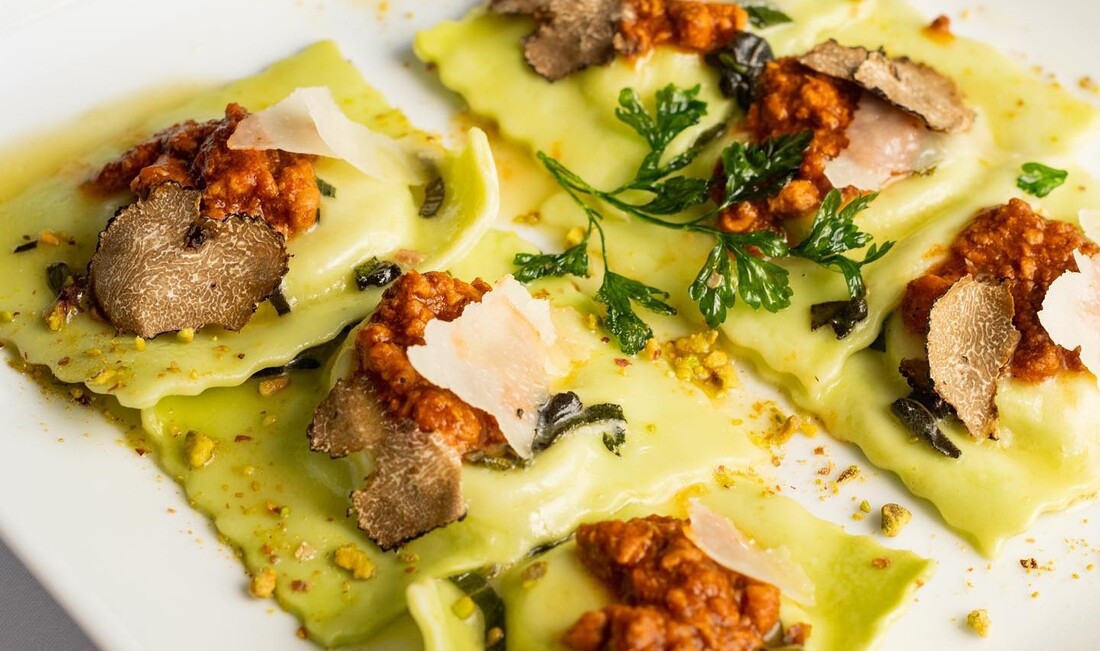
Ravioli filled with taleggio and topped with a wild boar ragu, shaved black truffles and pistachios at Amalfi in Houston
 RSS Feed